Week of Oct 19, 2026: Fear Index Drops From 52.5 to 31.6 as Hormuz Traffic Falls 98.9%

The alarm: the calm just broke
A week ago the Fear and Greed Index read 52.5, Neutral. Today it reads 31.6, Fear. Two of its four parts are now at Extreme Fear. Junk-bond demand scores 3.6 out of 100. Market momentum, the S&P 500 against its own 125-day average, scores 15.5. Last week we wrote that the bond market was nervous while the stock market was calm. This week the fear has spread.
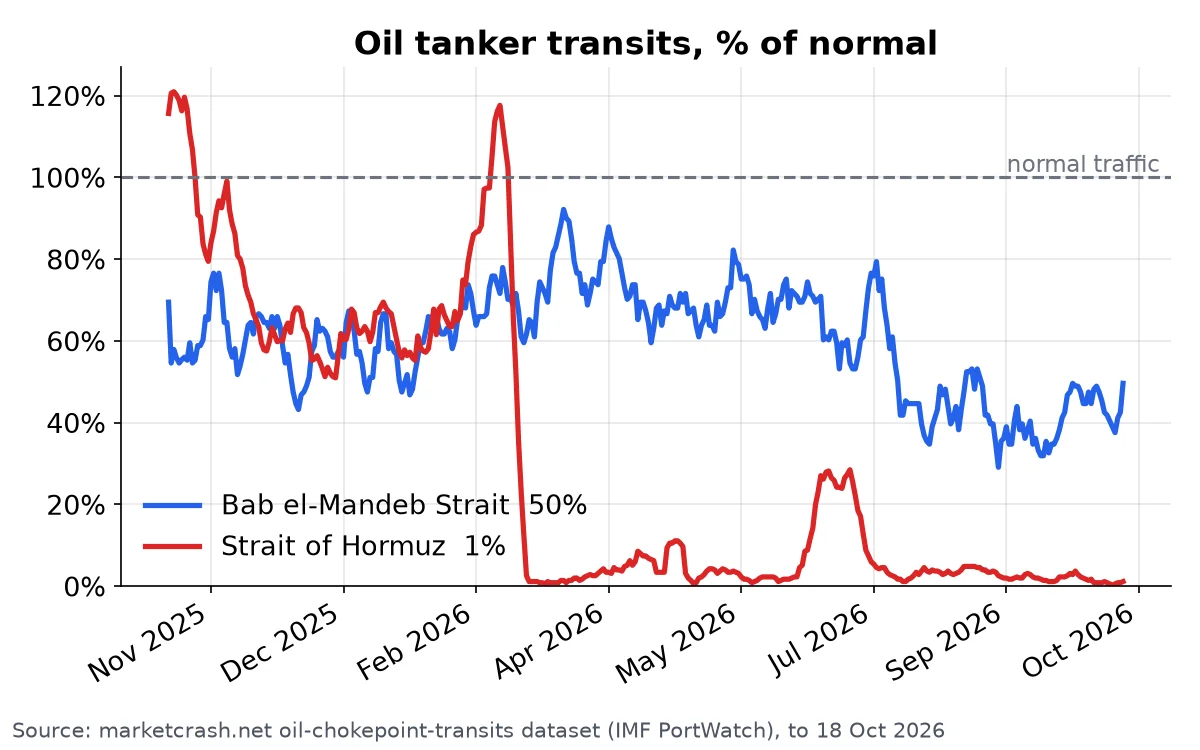
The cause has not gone away. Strait of Hormuz tanker traffic is 0.57 a day (Oct 11) against a normal 50.2. That is 98.9% below normal, worse than the 98.3% of a week ago. The Bab el-Mandeb runs at 8.57 a day against 20.1, 57.5% below normal (55.3% last week). No earlier shock closed both straits at once. The Oil Shock page still reads CRITICAL.
Brent crude is $126.55 (Oct 14), up from $125.44 and +55.8% in three months. In 1973 the embargo quadrupled oil and the S&P 500 lost 48%.
The other big moves
Treasury Dump: CRITICAL. Japan, the largest foreign holder of US debt, holds $1.07tn. That is 9.77% less than a year ago and $35.7bn less than a month before (Aug 1). If Tokyo sells to defend the yen, every rate keyed to Treasuries rises.
10-Year Treasury yield: 5.10% (Oct 15), down from 5.22%, but still +0.55 points in 90 days. The 30-year pays 5.43%. Interest already takes 16.50% of federal spending, on the way to the 23.48% record of 1991.
Shiller PE: 41, down from 41.9. That is still the 98.8th percentile since 1871. The only higher peak was 44.19 in December 1999, before the dot-com crash.
Buffett Indicator: 231.1%, down from 236.2%. Before the 2000 crash it was 146%.
Yield curve: 0.35%, down from 0.44%. It is the one crash signal still positive, and it is slipping.
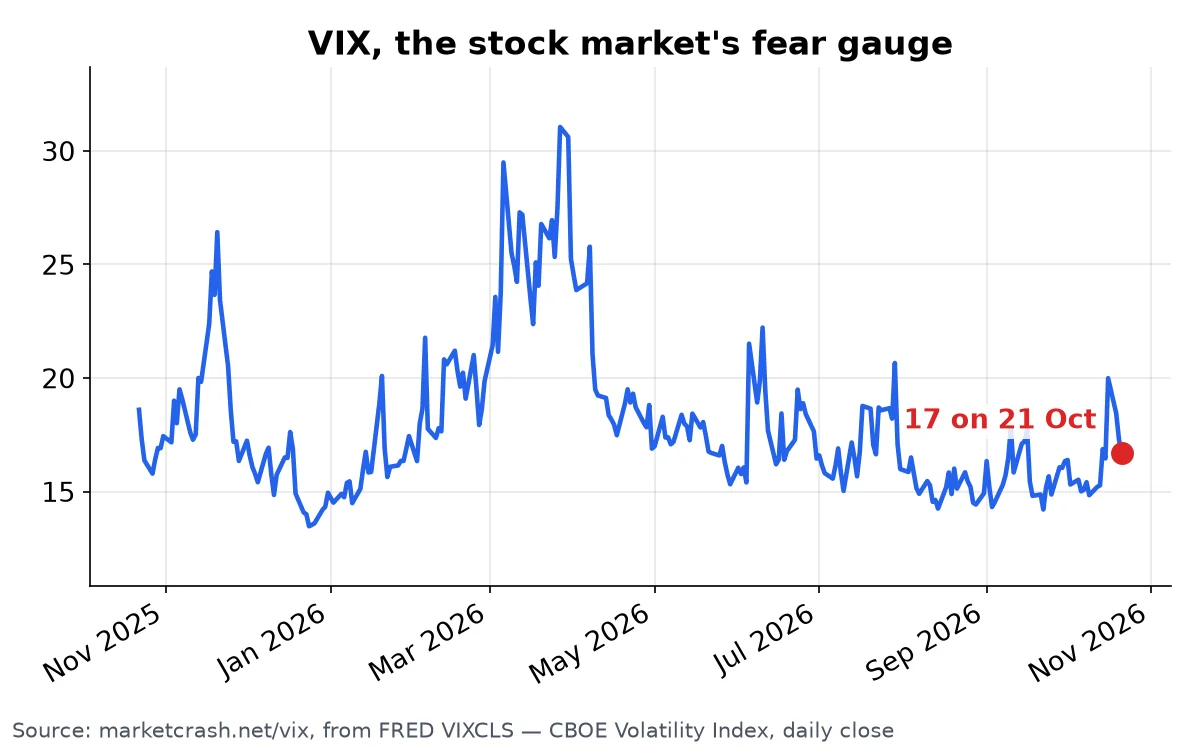
The crash-risk score holds at 67.0%, with two of three warnings on. The VIX is 16.46, up from 15.41.
A crash needs a market expensive enough to fall and a trigger. The trigger is on the board, and now sentiment is turning too.
This post describes data only. It is not investment advice.
Don't find out from the headlines. Get the week's biggest moves by email, at most once a week and only when something moved: subscribe on the MarketCrash dashboard.